Search This Blog

Showing posts with label Kampe. Show all posts

30 June 2025

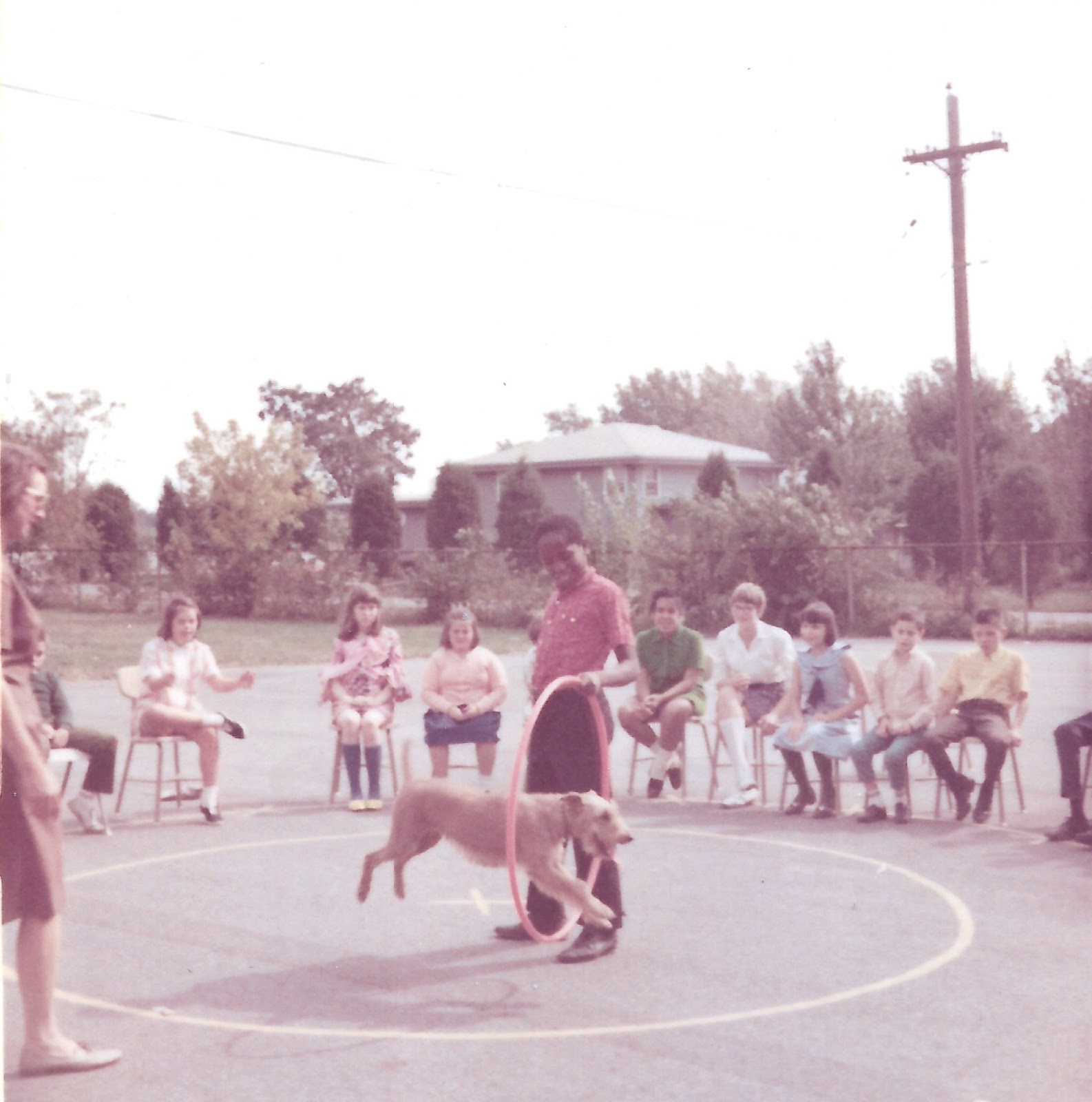
Great Plains K-9 School, Joliet, Illinois, 1962+


As sole owner and trainer of Great Plains K-9 School for 20+ years, I enjoyed providing care for all kinds of dogs. Grooming and boarding for dogs and occasionally cats occupied most of my time and home. 

What started as a hobby turned into a full time business. My desire to show my own Irish Terrier in AKC confirmation shows and obedience trials required entry fees, so my hobby turned into a neighborhood grooming business, then the grooming added group training classes, individual training classes and training other people's dogs. 
Invitations arrived to visit the Exchange Club, library, schools, Grundy County Speedway, and senior care homes (laughing, the least number of seniors fell asleep during our program). Please remember, this was the late 1960s, therapy dogs were unheard of at this time.  


Now I am into genealogy for 30+ years, Selma Kampe Shutt Blackmon aka Roots Drigger

07 March 2025

Barbara Ann Kampe, artist, -2023


Barbara Kampe presented me, her sister, with her painting “Three birds in a bush.” In 2001, I worked as an administrative assistant; Barb offered to spruce up my office. Originally there were three birds in the painting not living up to the artist’s sense of design, so bushes grew up and covered the birds. I never learned which bush hid the birds.

Barb was born in Joliet, Illinois, due to an unexpected snow storm in October my mom and baby sister spent a few extra days in the hospital. With this much excitement, I think the rest of her growing up years were “ordinary.” Since my sister and I are twelve years apart in age, I do not know much about her early life. As an adult, Barb moved from Illinois to Florida. Living in Florida offered her an opportunity to relax, enjoy and pursue her interest in painting. She painted everything from landscapes, flowers to horses. Barb’s art provided her an outlet to express her love for the outdoors. 


This blog was written to express my memories and appreciation for my only sister. Amy Johnson Crow has a program called #52ancestors. . Each week a different topic allows us to think about our families. This is in response to week 10 siblings. We can blog, share a note on Facebook on Generations Café or bury the memories and no one will know what we are feeling. My personal feelings for my sister include the fact that I wish we could have spent more quality time together. Barb came to Georgia several times and I did enjoy walking the sandy beach in Clearwater, Florida.

Barb’s life ended too young and too quickly in May 2023. Her memorial was live streamed for the out of town friends and family. Thank you First Presbyterian Church of Dunedin for your thoughtfulness. Barb’s art was on display. Several of her friends offered comforting words. One of her friends articulated that Barb found comfort in Reading her Bible, especially Romans 8:3838 For I am convinced that neither death nor life, neither angels nor demons,[k] neither the present nor the future, nor any powers, 39 neither height nor depth, nor anything else in all creation, will be able to separate us from the love of God that is in Christ Jesus our Lord.” This stirred childhood memories and comforted me. Two of my favorites include John 14:6Jesus answered, “I am the way and the truth and the life. No one comes to the Father except through me. “And Mathew 6:3333 But seek ye first the kingdom of God, and his righteousness; and all these things shall be added unto you.”

Relationship to me: Barbara Ann Kampe is my only sibling; see my public trees on MyHeritage.com and Ancestry.com

Happy tree climbing and roots digging,

Selma aka Roots Digger


24 February 2025

Family Migration


The article with this definition explains 12 Types of Migration (Human Geography Notes) (2025)

My family migration:

Maternal:

SCHULER, Johann Georg, b 1792 Endingen, Emmendingen, Baden-Württemberg, Germany, migrated to U.S.1833, died 1860 in Ohio, his descendants live in Lockport, Illinois today

ZIMMERMAN, Agnes, b 1787 Endingen, Emmendingen, Baden-Württemberg, Germany, migrated to U.S. in 1833 

VonGUNTEN, Anna, b1819 Canton Bern, Switzerland, migrated to U.S. in 1834, married in 1838 Wood County, Ohio, died 1887 in Lockport, Illinois

KEMPH, Magdalena VonGUNTEN, b 1812 Schwanden, Bern, Switzerland, married 1832 in Switzerland, migrated to U.S. in 1834, died1887 Lockport, Illinois, descendants live in Kansas, Montana and other western states

BAUMGARTEN, Lena, b 1842 Oldenburg, Saxony, Germany, migrated to U. S. in 1866, married 1864, raised family and died1916 in Lockport, Illinois

ARMSTRONG, Nathan Nelson, b 1831in Bradford County, Pennsylvania, migrated to New York then to Illinois, descendants migrated to Iowa and west coast, Washington, Oregon, California

Paternal:

KAMPE, Frederick, b 1826 in, Hanover, Germany, migrated to U.S. 1853 first to Mason County then to Will County, Illinois, died in 1908 in Will County, Illinois

ELSNER, Hans Caspar Friedrich “John”, b 1814 in Mecklenburg-Vorpommern, Germany, migrated to Frankfort, Will County, Illinois in 1863, died 1876 in Frankfort, Illinois, after the Civil War, several descendent families migrated together to Iowa KOERNER, LANGE (Long or Lang), ELSNER, late 1800s TENHOFF migrated from Iowa to Minnesota

Many other family surnames will be added to this list as I dig deeper and climb higher on my trees.

Relationship to me: both lineal and collateral ancestors on my maternal and paternal side

Family and friends help me to correct my paper mistakes and to add stories to the family. All of my research papers, photos and other “stuff” will be located in Alabama at a community college associated with a historical society. This collection is open to everyone. Online I am at MyHeritage and Ancestry aka RootsDigger or Roots_Digger.


09 January 2025

Elsner and Dunham photos provide clues


“Charles” Carl Friedrich August Elsner, 1852-1941

     Years ago, someone gave me, Selma, this 1940 photo of “Charles” Carl Friedrich August Elsner, 1852-1941. Charles lived in Frankfort, Will County, Illinois. The photo shows great-grandpa Elsner holding baby Selma on his lap in a rocking chair in his parlor. Why is this important to me? This connects me with my paternal ancestors. If you had time to read my first blog in this #52ancestors series, you will remember that I do not have verbal stories passed down from the families. This tells me great-grandpa cared enough to want a photo with me. In this family, the men provided for their families by working hard. The families were not physically demonstrative as some people today.

     My mom expressed at one time her difficulty in asking for or giving hugs. Mom said, “My father provided for our family, but I never saw him hug anyone.” She added that her father never told her that he loved her, yet she did not doubt his love because of his provision for his family. My own experience with my family of several generations was the same.

     When I went to Lockport, Illinois, (maternal side) with the family, I went outside and played, usually by myself. When I went to Frankfort, Illinois, (paternal side) with the family, I was given the choice to play outside, wonderful old summer kitchen or in the home, Grandpa Kampe had a very large roll top desk.  Between the side drawers, a box of toys included a large top and a wooden turtle with a pull string which keep me playing for hours. Grandpa would set in his rocking chair and watch me play while the adults visited. My son enjoyed playing with the toys; and I have a photo of my son sitting on his great-grandpa Kampe’s lap in a rocking chair. Great memories!!!


Who is Aunt Sarah Dunham? As the generations passed, I received more family photos; so “Aunt Sarah” started my genealogy climb. In the early 1990s, I posted her photo on every site that allowed questions. Was this “Aunt Sarah” by birth or by marriage? In 1993 my conclusion with thanks to P.C. Alger, Ann Eldred and others in New York who shared photos, “Aunt Sarah” was born a Dunham who married a Hickok. With this information, I joined the Dunham family association, again great help from Gratia Dunham Mahony and others. (I am currently a Dunham board member and V.P., check us out) Next challenge is what branch of the family? Thanks to DNA and my Dunham cousins Rich Capen and Christina Strieff, I have been added to the William F. Dunham branch of the family. Please for more family articles, read blogs or contact me.

    Great-grandpa Charles Elsner is probably my favorite photo, yet “Aunt Sarah” deserves credit for introducing me to the world of genealogy with enjoyment of 30+ years and still searching for more family and memories. Thank you everyone!!!

06 January 2025

In the beginning...Selma Kampe, 1939, who is she?


     Selma Kampe, 1939, who is she? Who am I? My mom, Mildred Schuler Kampe, told me, “I know nothing about my family. As a child I played with some children that were family, but I never knew how we were related.” Mom would continue by adding that when someone came to the front door, no matter the weather, the children went outside. Mom knew names such as Couch, Thayer, Armstrong, Woodin, Morey because the family would travel from Lockport, Illinois, to LaSalle County, Illinois, to visit “family.” As an adult, it was Wilma Woodin Morey that added connections. In the 1990s when I started genealogy, mom told me that there was no family information anywhere. She was surprised when I added connections to the family names from my research.

     As a child, I was curious, “Where did we come from?” I was told to sit in the corner and keep quiet, don’t ask questions, don’t pester the old people. Until, I met Joey Blackmon and he opened up a whole new world of research using public records such as census and newspapers. Now at 85 years old, I want to keep my research public and encourage others to share. I am in the process of donating all of my collection to a community college museum. My research will never be complete; I  am currently organizing the material as follows:

My six generations include me as generation1 are color coded and numbered. The plan works with both digital and paper folders. My paper folders are third cut, the center tab is for my direct line, the left tab is for my collateral line, the right tab is for surname research. The colors chosen are paternal blue and green, maternal red and yellow.

 Generation 1: Selma Kampe, 1939 - 01, blue, green, red, yellow

Generation 2: Henry Kampe, 1916-1983 / Mildred Schuler, 1919-2008 - 02 blue and red

Generation 3: William Kampe, 1883-1960 /  Selma Elsner, 1887-1928 -  03 blue

                       William Schuler, 1871-1964 / Nettie Couch, 1885-1965 - 03 red

Generation 4: John Kampe, 1847-1917 / Anna Dralle, 1859-1950 – 04 blue

                       Carl “Charles” Elsner, 1852-1941 / Karolina Koppelman, 1861-1933 – 04 green

                       John Schuler, 1841-1916 / Lena Baumgarten, 1842-1916 – 04 red

                       Eugene Couch, 1851-1925 / Laura Armstrong, 1857-1931 – 04 yellow

Generation 5: Fredrick Kampe, 1826-1908 / Charlotte Heumann, 1826-1895 – 05 blue

                       Frederick Dralle, 18131874 / Sophia Sieling, 1825-? – 05 blue

                       Hans “John” Elsner, 1814-1876 / Sophie Wrede, 1819-1910 – 05 green

                       Frederich Koppelman, 1825-1891 / Maria Prestin, 1835-1891, 05 green

                      John Schuler, 1815-1875 / Anna VonGunten, 1819-1887 – 05 red

                      Christian “Charles” Baumgarten, 1804-1868 / Henrietta Ronitz, 1812-1979 – 05 red

                      Elisha T Couch, 1820-18-96 / Jane Dunham, 1923-1906 ‘ 05 yellow

                      Nathan Armstrong, 1831-1895 / Jane Baker, 1939-1879 – 05 yellow

Generation 6: Kampe/Heumann unknown

                       Dralle unknown

                       Frederich Sieling, ?-? / Louise Hohler, ?-? – 06 blue

                       John Elsner,  1780-? / Augustine Adam, 1779-1841 – 06 green

                       Frederick Wrede, 1783-? / Maria Adam, 1789-? – 06 green

                       Ernst Koppelmann, 1791-1846 / Dorothea Strubing, 1798-1875 – 06 green

                       Fredrich Prestin, ?-? / Christine Schween, ?-?, 06 green

                       Johann Georg Schuler, 1792-1860 / Agnes Zimmermann, 1787-? – 06 red

                       Johannes VonGunten, 1798-? / Elisabetha Buhler, 1788-? 06 red

                       Johann Baumgarten, ?-? / ?, 06 red

                       Karl Ronitz, ?-? / ? – 06 red

                       Elisha Couch, abt 1776-1854 / Lucy Loveland, 1778- abt 1854 – 06 yellow

                       William F. Dunham, 1799- abt 1880 / Sarah Metcalf, 1803-1887 – 06 yellow

                       Mathew Armstrong, 1801-1870 / Elinor Nelson, 1808-? in CA – 06 yellow

                       Eldridge Reynolds Baker Sr., 1803-1878 / Lara Woodruff, 1800-1888 – 06 yellow

      Next question; how do I know that fact? Every fact needs a citation; where did it come from even if it is only someone’s tree. Daily I learn new things and/or ways. Now I have family and friends encourage me and hopefully I am encouraging others. My personal “in the beginning…”starts with Genesis 1 and genealogy in Genesis 5, 10, 11 and Matthew 1. My Aunt Eleanor Schuler Boldt taught me Matthew 6:33. She lived her life as a great example to me. As in the Bible, God is interested in genealogy/families; I am also to be interested in individuals.


03 October 2021

Kampe & Elsner Families lived in Frankfort, Will County, Illinois, from the mid 1800s+


On 31 August 2016, the Illinois Genealogical Society held a Farm and Family night during the Federation of Genealogical Societies yearly conference. In order to honor my paternal heritage, I represented the Kampe and Elsner families. Frankfort, Will County, Illinois, holds many memories for the Kampe and Elsner families. Both families migrated from Germany in the middle 1800s. Both families raised their children on area farms. The Elsner farm was located west of Frankfort. Today if I drive south on Elsner Road  from Route 30, I would find representatives of most of the township founding families buried in the Pleasant Hill Cemetery on the left. Between the cemetery and the current post office, I may stop for bicycle or pedestrian traffic enjoying the Plank Road Trail, former railroad tracks. In 2014, we took several bike rides from Joliet east to Frankfort on this trail. The trail passes the location of the last Kampe farm. William Kampe lived at the west edge of town, north of the train track and east of Pleasant Hill Cemetery. William and Selma Elsner Kampe raised Henry Kampe, my dad, on this farm. Driving on past my stop down memory lane and the trail, I continue just a short distance and find on the right Brookridge Creek School which was built in the mid 1990s. This was built on the location of the Elsner farm.

John Elsner and his family arrived in Illinois during the summer of 1863. He purchased his farm from Levi Doty In 1865. The farm land estate transferred from John, 1814-1876, to Charles, 1852-1941, to George Wilhelm, 1884-1979, to Dorothy Elsner Porter, 1918-2016.  Dorothy and Mildred Schuler Kampe, my mom, enjoyed meeting for lunch once a week. A few times when in Illinois, we had the privilege of joining them. After my mom passed, we stayed in touch with Dorothy by phone and our occasional trips to Illinois. Dorothy allowed me to scan her scrapbook and family documents. A few of the farm memories Dorothy shared include:

  • ·   She did no farm work; they had hired help for the care of the animals and gardening
  • ·         No one except the farm workers were allowed near the milk cows; if upset, the cows would not give milk
  • ·         The hired workers had their own quarters upstairs with a private back entrance; they shared meals with the family
  • ·         The farm was listed as grain and dairy. The milk was sold to Hickory Creek Creamery Company which closed in 1895; subsequently the milk was collected by Bowmen Dairy of Chicago, Illinois
  • ·         As the farm was west of Frankfort, they had electricity before the town people. The electric lines were installed from west, Joliet, to east, Frankfort
  • ·         During the cold, snowy winters, Dorothy lived with family in town and attended school
  • ·         During WWII, her brother, George, was drafted. No men were available to hire. Robert, her husband, and Dorothy returned home to help with the crops. This lack of help ended the “hands on” farming. The cows were sold. The family leased their land and farm equipment

Fred Kampe, 1826-1908, and his family arrived in the U.S. in 1854. They lived in Mason County then Frankfort, Will County. In 1878 his farm east of town consisted of 325 acres valued at $15,000 according to the Will County History by Woodruff. The farm was located on Sauk Trail Road. My direct line includes Fredrick Kampe, 1826-1908, John Kampe, 1857-1917,who lived on the family farm. By the 1910 census, John was living in town. In 1910, William Kampe, 1883-1960, was living on the family farm with his new bride, Selma Elsner. Next, William and Selma moved to the farm on Railroad Street. The exact date of their move is unknown at this time, but I have photos of Henry, 1916-1983, as a baby in the yard. Henry Kampe was my main source of information on their life:

  • ·         William Kampe was the first person in the area to drive cattle into the Chicago Union Stock Yards by truck
  • ·         Daily Henry would walk the cattle to and from what is now Van Horne Woods to graze. He collected many arrowheads during these trips circa mid 1920s

My farm memories from the late 1940s and early 1950s:

  • ·         During corn harvesting, I rode in the horse drawn wagon from the field to the barn. I ate with the workers. Even as a young girl, I preferred outdoors with the animals to indoor cooking.  I held a three week old baby pig and could not understand why I couldn’t have a pet until my grandpa showed me the sow
  • ·         William’s occupation was stock dealer; my grandpa was a great judge of horses and cattle. I wanted to learn to judge animals too. Every Thanksgiving weekend, we would go to Chicago to the 4-H stock show and horse show
  • ·         Sundays and holidays included dinner at the farm. Easter always incorporated an outdoors colored egg hunt for the grandchildren
  • ·         Since I loved animals so much, chickens included, when grandpa saw us drive down the lane, all the chickens were locked safely in their coup. I did raise two chickens, Snowball and Midnight; when they grew up they moved to the farm. I had to see them each week before I would eat dinner
  • ·         I did play in the fields and the summer kitchen next to the barn

My connect ion, these were my paternal ancestors. Preparing for the Farm and Family program brought back great memories. too many memories for one article.

View my research trees on Ancestry and MyHeritage as Selma Blackmon or Roots_Digger


10 July 2021

Henry J Kampe, 1916-1983, was this his sled?


“The sled belonged to your father.” This message has been passed down to me for years. Is this true or false?


Maybe it was not a dream; I remember seeing tracks down the hill at grandpa’s home in Frankfort, Will County, Illinois. The photo included in this blog is me on a sled in February 1943. Since I was born 1 August 1939, I would have been three and a half years old. The dream or memory in my mind plays out of descending down the long, to a child, gentle hill. I remember various tracks in the snow from numerous trips up and down the side yard.

 Is it possible that my dad had a flexible wooden sled? Yes, according to Wikipedia.com, “Samuel Leeds Allen patented the Flexible Flyer in 1889…” 

Flexible Fliers are flexible both in design and usage. Riders may sit upright on the sled or lie on their stomachs, allowing the possibility to descend a snowy slope feet-first or head-first. To steer the sled, riders may either push on the wooden cross piece with their hands or feet, or pull on the rope attached to the wooden cross-piece. Shifting the cross-piece one way or the other causes the flexible rails to bend, turning the sled.”  Comparing my sled model with online photos, this sled may have been designed in the 1920s.

  The Photo Detective, Maureen Taylor, reminds us to wring out every detail in a photo. My dad’s hand writing provides the date as February 1943. Selma on the sled is the subject. This leaves only the location in question. Concrete blocks, tires and wood scraps appear in the upper half of the original photo. HINT: scan ALL of the original photo, keep original scan, crop for publication.

family
With my family staying in Will County, Illinois, the following are three possible locations:

  • 1.    My maternal grandparents, the Schuler family lived at 815 Madison Street, Lockport. The garage was wooden. In the front yard was a short steep hill ending at the curb.
  • 2.    My dad had purchased an old house at 56 Herkimer Street, Joliet. He remodeled this into six apartments. It would have had a back porch that may have had blocks, but doubt the tires. I doubt this was the place, very small yard, no hill. I attended first grade 1945-1946, so I doubt he owned the building in 1943.
  • 3.    My paternal grandfather, William Kampe, lived at the edge of Frankfort. My dad grew up on this farm. The buildings consisted of the original barn with adjoining equipment shed, summer kitchen, garden, chicken house and home. All the buildings appeared to be the same vintage. Except, a large concrete block garage looked out of place at the end of the gravel turnaround between the garden and the chicken house. The garage was definitely more modern than the rest of the buildings.

 With these three choices, I would choose Frankfort. We visited often. It would be the safest for a three and a half year old child to slide down the grassy hill and stop safely with no traffic. Dad and his father were probably out working in the garage when I stopped at the bottom of the hill.

If this is my dad’s sled, they could have been cleaning out the garage as many of us are attempting to do today. Thank you, Deborah; the sled has a great new home. May this article be a tribute to the sled, my dad, my grandparents and many fond memories!!!

 Comments, Selma Kampe Blackmon, sbgenealogy@gmail.com.

05 September 2020

Family historians slow down! Document! Analyze!


Family historians slow down! The question is not how far back does your line go? The question should be what documents have you analyzed to arrive at your conclusions? Document! Document! Document! Analyze! Analyze! Analyze! Then start again and reread what you have written.
Slowly research each generation. Document each person with connections to your tree. How do you know you connect? "Aunt Mary told me." Great start! Now evaluate the information and search for substantiating evidence. Lack of a paper trail does not lead to shame; it leads to research plans. Write a list of names; assemble everything you can find that include these names. As you pull together your research, date the information, identify photographs and source your records.
Try free genealogy software until one program stands out from all the rest. Does this program feel comfortable? Will this program accomplish my goals? For me, Roots Magic meets my needs. It provides me with a citation template and drag and drop between databases. Multiple databases may be organized around surnames in a location such as "Dunham in Wisconsin." Plan a database of connected families such as my "SchulerKampe family tree" or unconnected people in my "SchlerKampe Who Not Connected." When people from the "Who Not Connected" are identified as family members, a quick drag and drop between databases changes their status. A database called "SchulerKampe lineage" contains direct and documented family names. My "SchulerKampe family tree" includes family interviews, vital records, obits and other newspaper stories. Eventually, this will feed the family narratives. My "SchulerKampe lineage" database includes evidence to connect each generation.
The lineage database starts with me. My birth fact has one document, my birth certificate. The paper (source) has been cited, transcribed and digitized before placing it in a safe place. My birth certificate provides the date, location and names of my parents including my mother's maiden name. No other records provide contradictory statements. Roots Magic software allows events to be shared. My birth fact has been shared with my parents. This connects me to my ancestors.
Generation two (1916-2008) consists of my parents. All reports that include their death, marriage and birth facts have been cited, transcribed and digitized. One database (SchulerKampe family tree) will contain ALL collected data. As there are no records with contradictory statements, the lineage database will have three events for dad and three events for mom. Each fact will be backed up with a source. This is a total of five pieces of paper. Automatically the software shares my parents marriage fact. My dad's birth fact has been shared with his parents. My mom's birth fact has been shared with her parents.
Generation three (1871-1965) consists of my grandparents. In each generation, acquire death, marriage and birth accounts. States did not require statewide vital records until around 1916; research at the county or town level. IMPORTANT, learn the laws of the area you are researching. Look for church records. Look for delayed birth certificates. My delayed certificates are dated 1938 to1942. With a record distant from the event, attempt to verify against earlier records. One of my grandfather's cousins delayed birth certificate states her birth as 1886, but this person is named in the 1880 U.S. census. The correct date is 1876. Research has verified that this is not a death of a child and reuse of same name.
Generation four (1840-1950) consists of my great-grandparents. This generation provides various challenges with opportunities to apply the genealogical proof standard. A few of my challenges include:
  • lack birth records
  • birth in foreign country
  • three different birth years
  • identity of parents when foreign country
  • birth information multiple sources offer multiple locations
All of the above provide many hours of research opportunities.
Generation five (1806-1910) consists of my great-great-grandparents. Most of the dates are approximate or missing. This generation presents countless exploration occasions. Start with known records and search other family members, church records, land deeds and court records.
My research records are public on Ancestry and My Heritage. My tree is Roots_Digger. Look for record matches, DO NOT accept family trees without documents.